

"AZUMASYUSAKU" Branch Lopping Japanese Ax, Anchor Shackle Type Aogami Steel Blade Double Bevel 500g
Sale price
Price
$245.00
Regular price
Unit price
per
"AZUMASYUSAKU" Branch Lopping Japanese Ax, Anchor Shackle Type Aogami Steel Blade Double Bevel 500g
Specification
■ Size:
Total length approx. 360mm, total length with sheath approx. 390mm
Blade length: approx. 160 mm, blade width: approx. 73 mm (maximum), blade thickness: approx. 7 mm
Handle Length: approx. 195mm Width: approx. 50mm (maximum) Thickness: approx. 29mm
Scabbard Length: approx. 260mm Width: approx. 105mm Thickness: approx. 35mm
* Belt loop included
■ Weight: Approx. 614g (body) Approx. 860g (including sheath)
■ Material: Blue paper steel + mild steel
■ Blade shape: Double-edged
■ Blade finish: Black finish
■ Features:
This is a fire-forged product by one of Tosa's leading hatchet smiths.
The blade is a strong and beautiful blade made by inserting blue paper steel into extremely soft iron and forging it using free forging.
The blade is not polished but is left as it is after hardening with a black finish.
The blade is designed to be ideal for pruning, which was arrived at by craftsmen through repeated trial and error.
This means that it is possible to cut straight down along the trunk of branches that are difficult to cut with a saw.
It is difficult for branches to remain, and the bark wraps around the tree quickly, reducing the strain on the tree.
In addition, the sharp cutting edge means that branches can be cut without straining the blade.
This hatchet is ideal for cultivating valuable knot-free wood.
The sheath is made of magnolia wood, which is moderately soft, does not damage the blade, and is excellent at preventing moisture from entering.
A first-class woodworker has carefully finished it with attention to detail while making the most of the wood grain.
It is finished with a paint that is water-repellent and stain-resistant, making it a sheath that is not only good-looking but also highly practical.
Furthermore, the leather used for the sheath is genuine leather, and you can see that the leather craftsmen have spared no effort in their work, from cutting to edge treatment and twisting.
This is an exquisite pruning hatchet that will give you both the joy of using and the joy of owning it as a tool.
■ Caution:
The hatchet is designed to have some play when stored in the sheath so that it will make a rattling noise every time you walk to scare off bears.
Please be careful that the blade does not pop out.
As this is a handmade product, there will be individual differences.
Item no. 4580149743168
Authentic specifications made with the finest craftsmanship!
The hatchet is forged and forged by a highly skilled, genuine hatchet blacksmith from Tosa.
This is a masterpiece that has been carefully crafted with the utmost attention to detail, with uniform thickness, a straight back and tip, and a sharp blade.
 |
 |
 |
 |
 |
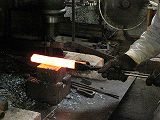 |
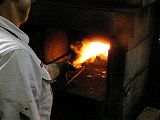
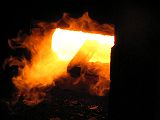
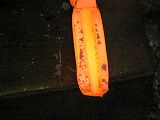
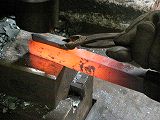
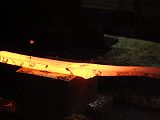
Each knife is split into two pieces by hot hammering, steel
is manually inserted between the two, and then the shape is skillfully fire-forged with a hammer.
The steel used is blue paper steel, which is hard, tough, and has a sharp cutting edge.
This is not a cheap product made by lightly hammering composite material. It is the real thing, forged with great care.
Handmade products have their own unique charm and character that set them apart from factory-made items. While factory-produced goods may strive for flawless perfection, the beauty of handmade lies in its individuality and the human touch behind every detail. Each piece tells a story, making it truly one-of-a-kind.
About the Steel's Surface Coloration
Due to the traditional forging process, the steel may occasionally display subtle changes in surface color.
This coloration is a natural residue formed during water quenching—a cooling technique where the heated steel is immersed in water. Prior to quenching, the blade is heated in molten lead at approximately 800°C. To prevent lead residue from adhering directly to the steel, blacksmiths coat the blade in a layer of mud, the composition of which varies by artisan. The resulting color is often due to the mud layer partially peeling away, a distinctive hallmark of the process.
While oil quenching tends to yield a more uniform, lustrous finish, water quenching may produce unpredictable yet authentic textures and hues—especially depending on the mud preparation. Despite its visual irregularities, water quenching remains a pinnacle technique in Japan, renowned for producing steel that is significantly harder and more resilient than oil-quenched alternatives.
These natural variations are not flaws—they are a testament to the blade’s journey through fire, earth, and water, and to the skill of the blacksmith who shaped it.
Import duties; taxes and charges are not included in the item price or shipping charges. These charges are the buyer's responsibility.


