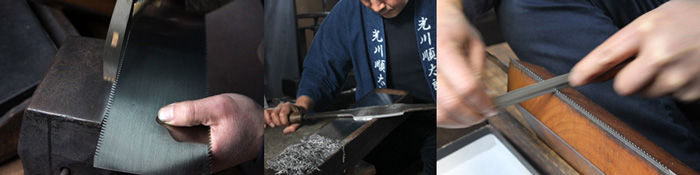

"Good work starts with good tools."
Banshu Miki forged blades are the ultimate carpentry tools chosen by professionals.
From the period of rapid economic growth to the present day, electric power has advanced in wooden construction sites, and hand tools have become less common.
The mainstream has become mass-produced houses, where components are cut using large machinery in factories owned by major home builders and then assembled on-site with nails and metal fittings according to blueprints.
However, the era of mass consumption is over, and from an eco-friendly and recycling perspective, traditional Japanese wooden-frame houses, which can last for over 100 years and are extremely resistant to earthquakes, are being re-evaluated.
There are still many young carpenters across Japan who wish to carry on traditional Japanese construction methods and do excellent work that satisfies them, both for their clients and for their own satisfaction.
For these people to master the intricate traditional woodworking techniques passed down in Japan since ancient times, and to perfect the high level of craftsmanship that involves delicate processing of the finer details,
they need high-quality hand tools that can accurately cut and shape the wood.
While the demand for handmade carpentry tools has decreased due to the advancement of electric tools,
in Miki City, Hyogo Prefecture, there are craftsmen who have inherited traditional techniques from the Edo period and are passionate about "making high-quality products."
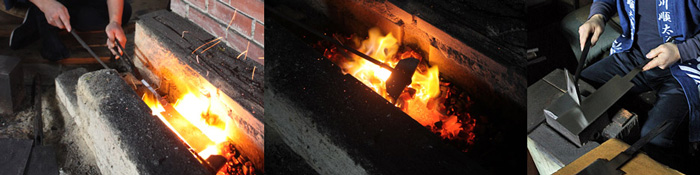
A century-old, three-generation tradition: each saw blade crafted with meticulous care and dedication.
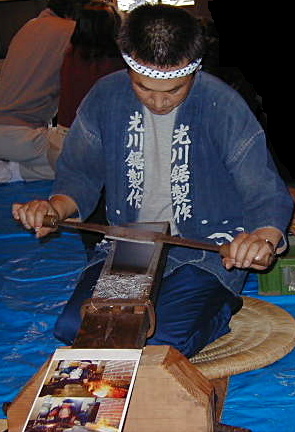
Juntaro Mitsukawa,
Third Generation Sawsmith Workshop,
Daizo Mitsukawa
The business began in the Taisho era with his grandfather, the first generation Juntaro, and continued through his father, the second generation Tadao, making it a history of approximately 80 years, now with the third generation Mitsukawa in charge.
While Juntaro mainly made knives for forestry and Tadao mainly made knives for carpentry, Mitsukawa makes a wide range of knives, from those for professional carpenters to those for hobbyists.
With the motto "Truly good products for everyone," he provides handcrafted sharpness without distinction between professionals and amateurs.
I've been a saw maker for 24 years. After graduating from high school, I apprenticed for two years with another saw maker in the city to hone my skills.
During that time, I received no pay. However, I learned every step of the process, from splitting charcoal to straightening warped blades and sharpening them.
Rather than learning theory or methods, I learned by doing, and by the time I was 20, the skills of saw making were "ingrained in my body."
Afterward, he began working at his family's factory. Although some parts of the manufacturing process were mechanized at that time, much of it was still done by hand using traditional methods.
His confidence in the quality achieved through handcrafted work and his pride in traditional techniques became the foundation for his confidence in each and every product.
In March 2000, at the age of 38, he became the youngest person in the city to be certified as a traditional craftsman.
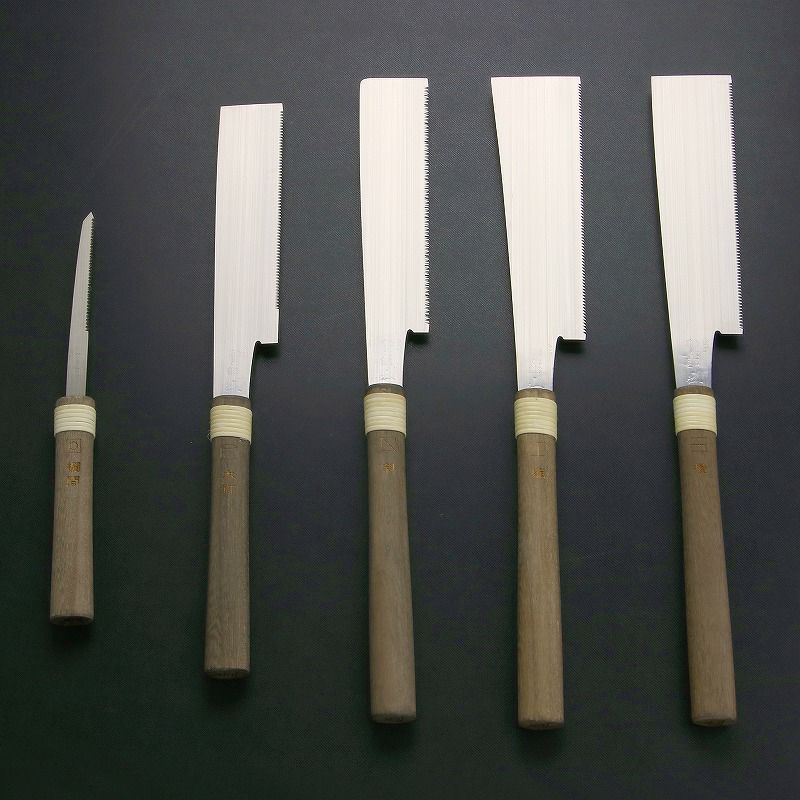
His skills are widely recognized, as evidenced by his involvement in the production of the pruning saw used by the Crown Prince for maintenance at the National Tree Planting Festival, and his "Third Generation Mitsukawa Daizo Craftsmanship Saw Set of Five" winning an award at the National Traditional Craftsmen's Association Exhibition this November.
"I am where I am today because I learned manual labor," he said, his words filled with conviction, stemming from the skills and confidence he gained through his own hands.
(From the Japan Cutlery and Tools Newspaper, December 10, 2003)